For every class · 15 minute staff session or on your own
The Morning Thread: How to Use It
A three minute read aloud at the start of class, with one life skill each week. It works for students and for adults, and it works best when a whole school follows the same thread together. Here is how to start, how a week runs, and a simple plan for sharing it with every class you teach.
Illustrations from Start With the Adult by Dr. Jessica Rose Mathy.
1. Start with you
Before you read it to anyone else, read it for yourself. Open the day's page in the morning, before students arrive. Read the line slowly. Ask yourself the question. That is the whole practice.
The Morning Thread is not only for students. It is a short moment to steady yourself, notice what you are carrying into the day, and choose how you want to show up. Some teachers keep it for themselves and use RoseThread Connect activities with their classes. Others share it with every class. Both are good ways to use it.
This is the same idea as the SSCC Practice™: regulate first, so you can respond instead of react.
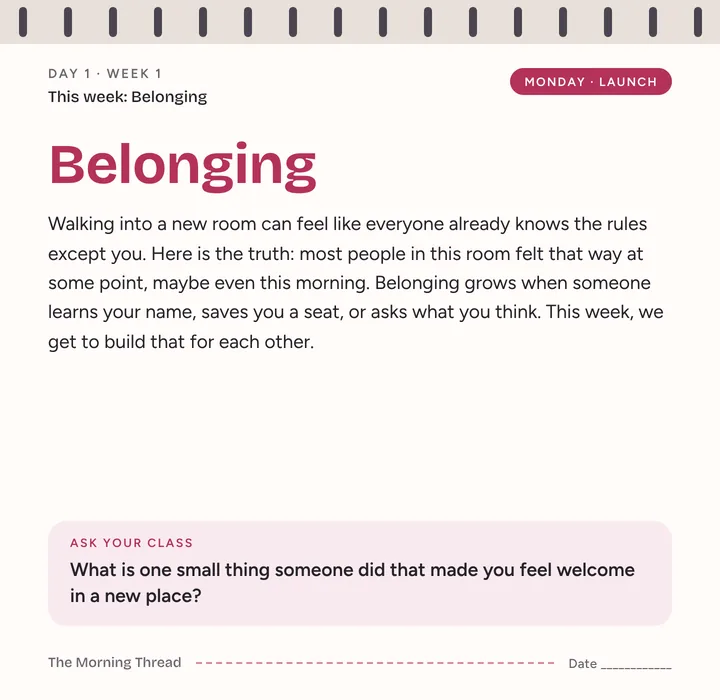
2. How a week works: launch, thread, reflect
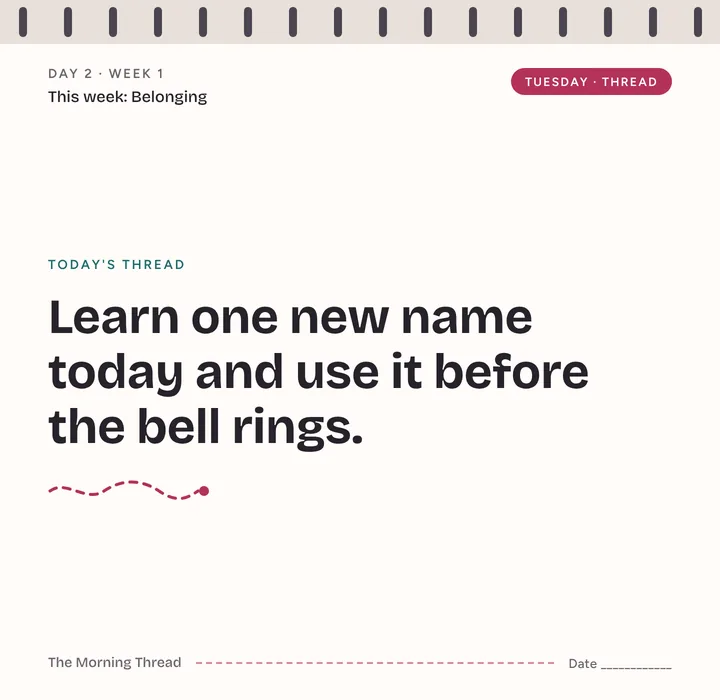
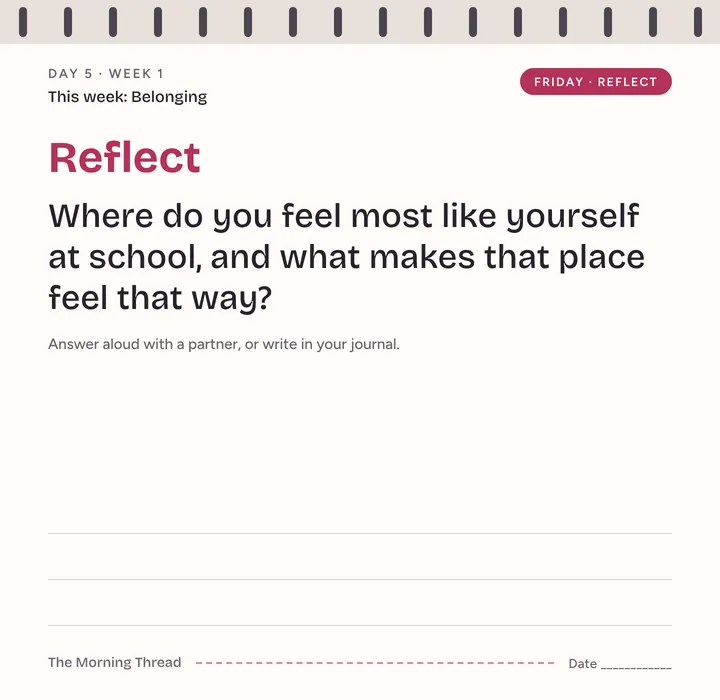
Every week has one life skill, and every week follows the same rhythm, so students know what to expect and the skill has time to sink in.
3. One school, one thread
All ten editions follow the same order: Core, English, Math, Science, History and Social Science, Fine Arts, Physical Education, Spanish, Spanish Advanced, and French. Day 1 is the same life skill in every edition, Day 2 is the same, and so on through all 180 days.
So when a whole school uses it, every classroom is on the same theme on the same day. The math teacher's question is about being stuck and trying again; the English teacher's question is about finding your voice; but the life skill is the same. Students hear it from more than one adult, in more than one class, in the language of each subject. Advisory, electives, and any class without a subject edition use Core.
4. Options for teachers: how much is up to you
There is no one right way. Pick what fits you this year, and change it any time.
| Option | What it looks like |
|---|---|
| Just for you | Read the day's page before school as your own morning reflection. Use RoseThread Connect activities with your classes. |
| One class | Launch on Monday, read the daily line, and reflect on Friday with one class all year, like advisory or first period. |
| Rotate the class | A different class period each week, so every class gets full weeks during the year. See the plan below. |
| Every class | Read the page to every class every day. It takes about three minutes. |
| The whole school | Every teacher on the same Day number, with the edition for their subject. Every class hears the same life skill. |
A simple plan: rotate the class
You do not have to launch and reflect with every class every week. Here is one way to share it with all your students without it taking over your week:
- Each week, choose one class period for the Monday launch and the Friday reflection.
- Move to the next period the following week. Week 1 is first period, week 2 is second period, and so on, then start over.
- Read the Tuesday to Thursday lines to any class you like, or to all of them. They take less than a minute.
- If the whole school rotates together, every teacher is launching with the same period on the same Monday, so the school's conversation moves through the day one period at a time.
| Week | Period 1 | Period 2 | Period 3 | Period 4 | Period 5 | Period 6 |
|---|---|---|---|---|---|---|
| Week 1 | Launch and reflect | Daily line | Daily line | Daily line | Daily line | Daily line |
| Week 2 | Daily line | Launch and reflect | Daily line | Daily line | Daily line | Daily line |
| Week 3 | Daily line | Daily line | Launch and reflect | Daily line | Daily line | Daily line |
| and so on | Over six weeks, every class gets a full week of launch and reflect. | |||||
The point is to thread it in on purpose, not to add one more thing. If one class a week is what fits, that is enough. If you want to read it to every class every day, that works too.
5. Make a Reflection Wall
Give Friday reflections a home. Students write their answers on sticky notes and post them on a class poster, so you can see what the week meant to every class.
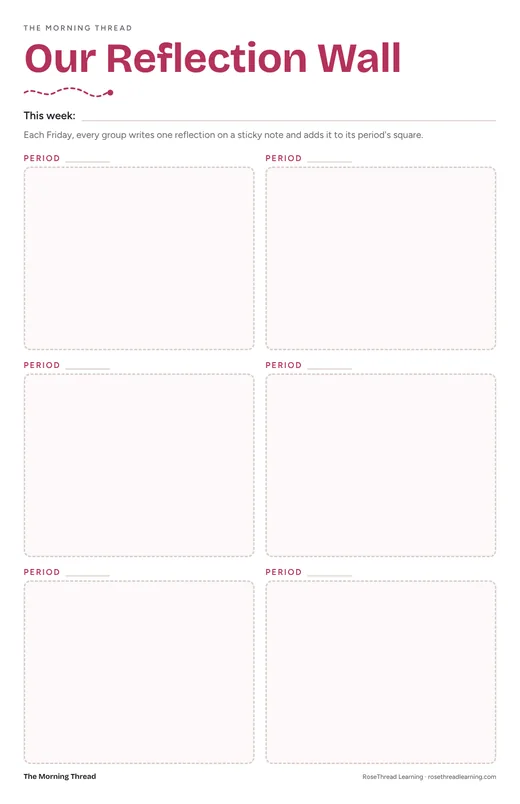
Make your own, for free. Use butcher paper or chart paper. Draw a line down the middle and across, or as many squares as you have classes, and write a class period in each one. Add a line at the top for this week's theme. The same poster works all year.
Or print ours. Six period poster (11 x 17 in) or one period sheet (letter), in English. In Spanish: póster de seis períodos or hoja de un período.
Or order printed posters from us for your classroom or your whole school. Tell us what you need.
On Fridays: groups of four talk through the question and write one answer on a mini sticky note. Each group sticks its note in its period's square. Take a photo, then clear the wall for next week.
6. Where RoseThread Connect fits
Every week of The Morning Thread is tagged with one of the five SEL skills, the same skills behind every RoseThread Connect activity. The Morning Thread is the daily three minute touchpoint. A RoseThread Connect activity is the 20 minute lesson that goes deeper, inside your own subject. The digital calendar links each week to RoseThread Connect activities for your course.
Use them together, or start with either one. Find this week's RoseThread Connect activity.
7. What the research says
The Morning Thread is a classroom routine, not a clinical program, and it has not been studied on its own. Here is the research behind the ideas it is built on, and what it does not promise.
- How we talk to ourselves matters. A meta-analysis of 32 studies found that self-talk improved performance on tasks, with the strongest effects when the self-talk was specific and practiced (Hatzigeorgiadis et al., 2011). Speaking to yourself by name, as you would to a friend, helped people stay calmer and perform better under stress (Kross et al., 2014).
- Reflecting on what matters to you can ease stress. Writing or thinking about personal values can lower defensiveness and stress in hard moments (Cohen & Sherman, 2014). Results in schools have been mixed: one large replication found no effect on grades (Hanselman et al., 2017). We use reflection to build the habit, not as a shortcut to test scores.
- Teachers set the tone. Teachers' own social and emotional skills shape their relationships with students and the climate of their classrooms (Jennings & Greenberg, 2009). That is why it starts with the adult.
- Short and respectful works better with teenagers. Programs that lecture adolescents about skills have a poor track record; approaches that respect their need for status and autonomy do better (Yeager, 2017). The Morning Thread is short, asks real questions, and never scolds.
References
- Cohen, G. L., & Sherman, D. K. (2014). The psychology of change: Self-affirmation and social psychological intervention. Annual Review of Psychology, 65, 333–371. https://doi.org/10.1146/annurev-psych-010213-115137
- Hanselman, P., Rozek, C. S., Grigg, J., & Borman, G. D. (2017). New evidence on self-affirmation effects and theorized sources of heterogeneity from large-scale replications. Journal of Educational Psychology, 109(3), 405–424. https://doi.org/10.1037/edu0000141
- Hatzigeorgiadis, A., Zourbanos, N., Galanis, E., & Theodorakis, Y. (2011). Self-talk and sports performance: A meta-analysis. Perspectives on Psychological Science, 6(4), 348–356. https://doi.org/10.1177/1745691611413136
- Jennings, P. A., & Greenberg, M. T. (2009). The prosocial classroom: Teacher social and emotional competence in relation to student and classroom outcomes. Review of Educational Research, 79(1), 491–525. https://doi.org/10.3102/0034654308325693
- Kross, E., Bruehlman-Senecal, E., Park, J., Burson, A., Dougherty, A., Shablack, H., Bremner, R., Moser, J., & Ayduk, O. (2014). Self-talk as a regulatory mechanism: How you do it matters. Journal of Personality and Social Psychology, 106(2), 304–324. https://doi.org/10.1037/a0035173
- Yeager, D. S. (2017). Social and emotional learning programs for adolescents. The Future of Children, 27(1), 73–94.
8. Run it as a 15 minute staff session
- Read Day 1 aloud to the staff (2 minutes). Use the Core edition. Ask the question and give everyone a minute to answer it for themselves.
- Show the week (3 minutes). Launch on Monday, one line Tuesday to Thursday, reflect on Friday. Show the ten editions: same Day, same theme.
- Pick the plan (5 minutes). Decide together: one rotating period each week, or every class. Agree on which period starts in week 1.
- Pick the day (3 minutes). Choose the Monday you start, and who writes the Day number on the board or in the morning announcements.
- Close (2 minutes). Ask each person to read tomorrow's line for themselves before school.
Want it for your department or your whole school? Get in touch for a group license.
The Morning Thread is a classroom read aloud and is not a substitute for counseling or other professional support.